


Want an AWP | Medusa? Start with its collection origin, not a generic case-odds chart. Medusa is a Covert skin from the Gods and Monsters Collection and is not obtainable from a Valve container. Skin.Club offers case opening, upgrades and battles, alongside a stated Provably Fair system, but those features do not establish current Medusa availability. This guide separates the skin's documented origins and contract rules from the uncertainty of trying to obtain it through a chance-based game.
What is AWP | Medusa?
AWP | Medusa is a CS2 weapon finish belonging to the Gods and Monsters Collection, introduced with Operation Bloodhound on 26 May 2015. Its rarity is Covert. Those details establish its identity, but they do not tell you that a particular case contains it, what an individual copy should cost, or whether a website currently has a withdrawable copy. Keep the collection, rarity and acquisition method separate: a skin can share a rarity with conventional case drops without sharing their source.
- Weapon
- AWP[↗]
- Collection
- Gods and Monsters[↗]
- Rarity
- Covert[↗]
- Introduction
- 26 May 2015, Operation Bloodhound[↗]
- Valve container source
- Not obtainable from any container[↗]
For someone seeking a playable copy, the useful distinction is between acquiring an existing item and paying for an uncertain outcome. The former lets you inspect a specific listing or trade offer; the latter requires checking a reward pool and its rules. Our CS2 skin comparison provides context alongside other collection and case-sourced items.
Where Medusa comes from—and why ordinary cases cannot drop it
Medusa's documented origin is the Gods and Monsters Collection, not a weapon case. The item record states that it is not obtainable from any container. Opening conventional Valve cases therefore is not a route to this skin, regardless of how many Covert results appear in those cases. Its historical collection association also does not establish an active collection-reward route today. A claim that Medusa currently drops somewhere needs a named, current reward pool—not merely a reference to Operation Bloodhound.
| Route | What is established | What to check |
|---|---|---|
| Conventional Valve container | Medusa is not obtainable from a container. | Do not apply a generic Covert probability to Medusa. |
| Historical collection rewards | The skin belongs to Gods and Monsters and dates to Operation Bloodhound. | Historical origin does not confirm current reward availability. |
| Trade-up contract | Eligible contracts produce a next-grade skin from an input collection. | Collection representation and eligible outputs must support Medusa. |
| Existing item listing or trade | A specific copy can be inspected before accepting an offer. | Confirm identity, condition, delivery restrictions and the final offer. |
| Skin.Club game result | The site offers custom cases and Upgrade. | Medusa must actually appear in the relevant current pool or target selector. |
A third-party site's case is a different product from a Valve container. Its contents depend on that site's displayed inventory and rules. Consequently, the absence of Medusa from Valve containers does not describe every possible custom reward pool—but neither does it prove that a Skin.Club case includes Medusa. Check the actual item list rather than a case name, illustration or theme.
Published case odds—and what they mean for an opening
General case probabilities help explain why rarity and item availability are different questions. The published figures below concern conventional case rarity tiers. They are not Medusa odds, and they are not Skin.Club's custom-case probabilities. First establish whether the desired item belongs to the pool; only then does a probability attached to that pool become relevant.
| Rarity tier | Published figure | Meaning for a Medusa search |
|---|---|---|
| Mil-Spec | 79.92% | A general case tier; it does not identify a Medusa source. |
| Restricted | 15.98% | A general case tier, not a collection-specific item probability. |
| Covert | 0.64% normal; 0.064% StatTrak | Sharing Medusa's rarity does not put Medusa in a case. |
| Rare special item | 0.26% normal; 0.026% StatTrak | This category concerns knives or gloves, not Medusa. |
CSGOSKINS.GG publishes the Mil-Spec and Restricted figures, attributing them to Valve; CS:GO Database publishes the Covert and rare-special figures shown here. They are quoted as reported, not combined into a new distribution. A rarity-tier probability is also not automatically the probability of a specific skin within that tier. Crucially, the StatTrak figures do not establish that a StatTrak Medusa exists.
Trade-up contracts: how crafting toward Medusa works
“Crafting” here means a CS2 trade-up contract, not selecting a skin and paying a fixed crafting charge. The ordinary contract consumes 10 eligible skins of the same grade and produces 1 skin of the next grade, selected from a collection represented by the inputs. All inputs must be normal or all StatTrak. For Medusa, the relevant route is a qualifying contract into Covert outputs with Gods and Monsters represented appropriately—not an arbitrary bundle of unwanted skins.
- Establish the eligible output gradeMedusa is Covert, so an ordinary contract intended to produce it must use eligible inputs from the preceding grade. Inputs of unrelated grades cannot be assembled into the same ordinary contract.
- Check collection representationThe output comes from an input collection. A contract without the relevant Gods and Monsters representation cannot acquire Medusa merely because the inputs are expensive or visually similar.
- Validate every inputSouvenir skins, knives and Contraband skins are excluded from ordinary trade-up inputs. Covert skins are also excluded from the ordinary 10-input contract; a separate Covert-input rule is discussed below.
- Review the complete output setMixed collections are allowed, but their presence changes which collections can supply an output. Check the eligible outcomes and contract details before submitting; the Medusa name alone is not a complete recipe.
| Contract branch | Documented rule | Relevance to Medusa |
|---|---|---|
| Ordinary grade progression | 10 same-grade inputs produce 1 next-grade output. | The relevant framework for producing a Covert collection skin. |
| Mixed-collection contract | Collections may be mixed; outputs come from represented collections. | Other collection inputs introduce other possible collection outcomes. |
| Covert-input branch | Since 22 October 2025, 5 Covert inputs can produce a knife or gloves; 5 StatTrak Covert inputs produce a StatTrak knife. | This is not a recipe for producing Medusa. |
No named Medusa input recipe or exact contract success percentage is established here. Do not substitute a rarity probability from the case table for a contract calculation: they describe different mechanisms. Likewise, do not assume an output float or condition from input labels alone. Confirm current contract eligibility and output behaviour before consuming items, particularly when following an older guide.
Wear, float, patterns and StatTrak: inspect the exact copy
Wear labels, numeric float and finish pattern describe different properties. A wear label groups a skin into a condition category; the float provides a more precise wear value. A pattern identifier concerns the finish's application. None of these changes Medusa's collection or makes it eligible for a case that does not contain it. For an existing copy, inspect the actual item rather than relying on a generic catalogue image.
- Check identity first: the offer and inspection details should name AWP | Medusa, not simply display an AWP thumbnail.
- Read the exact wear information. Do not infer a Medusa-specific float interval or every possible condition from generic skin terminology.
- Inspect the finish under useful lighting. A cropped seller image can conceal areas that matter to your cosmetic preference.
- Treat special-pattern claims as unverified until supported by the exact item details and a credible explanation of what makes that pattern distinct.
Avoid unsupported pattern and condition claims
An exact Medusa float range and a Medusa-specific pattern ranking are not verified here. A pattern number by itself is not evidence of a premium, and cosmetic preference is not an objective pricing rule. If a listing makes a special-pattern claim, ask for inspectable item details rather than accepting a nickname. The same discipline matters when reading our separate Case Hardened pattern guide: pattern concepts should not be transferred indiscriminately between finishes.
Do not infer StatTrak availability from rarity
Medusa-specific StatTrak availability is not verified here. General StatTrak case probabilities and the rule requiring matching contract input types do not establish an individual skin's available variants. Verify the item record before accepting a listing described as StatTrak Medusa. The skin glossary explains the broader distinction between rarity, condition, float and variant labels.
Safer ways to obtain and receive a tradable copy
If your goal is ownership rather than chance-based entertainment, inspecting an existing copy avoids uncertainty about which skin an opening or upgrade will produce. It does not eliminate transaction risk. On the Steam Community Market, purchases and sales use Steam Wallet funds, and the purchase dialogue displays fee lines. A Steam trade offer instead packages the items being exchanged on each side. These are general Steam mechanisms, not Skin.Club-specific terms.
- Inspect the item before agreeing. Check the name, wear details and any claimed variant against the actual listing or offer.
- Review both sides of a trade. A familiar account image or display name does not establish that the offered item is correct.
- Keep Steam confirmations inside Steam. Do not give another person your password, authenticator code or recovery information to receive a skin.
- Check restrictions before committing. A trade hold concerns delivery timing; it does not improve the item or establish that the counterparty is trustworthy.
- Compare the final transaction terms rather than a headline figure. Steam fees and any separate service terms must not be mistaken for Skin.Club's fee policy.
Steam Guard's mobile authenticator provides additional authentication for trade and market confirmations. Valve describes a trade hold as a period during which Steam holds items before delivery, allowing an owner to cancel a fraudulent trade after an account compromise. Do not assume that another person's delivery experience establishes the hold status of your account or of a particular Medusa copy.
If an offer is missing, inspect its actual Steam status before accepting a replacement. If the item differs from what you agreed, stop rather than treating a support chat as permission to ignore the discrepancy. If delivery is held, distinguish a Steam hold from a site's own processing state. Our trade-safety guide covers account checks and suspicious-offer warning signs.
Upgrading toward this skin on Skin.Club
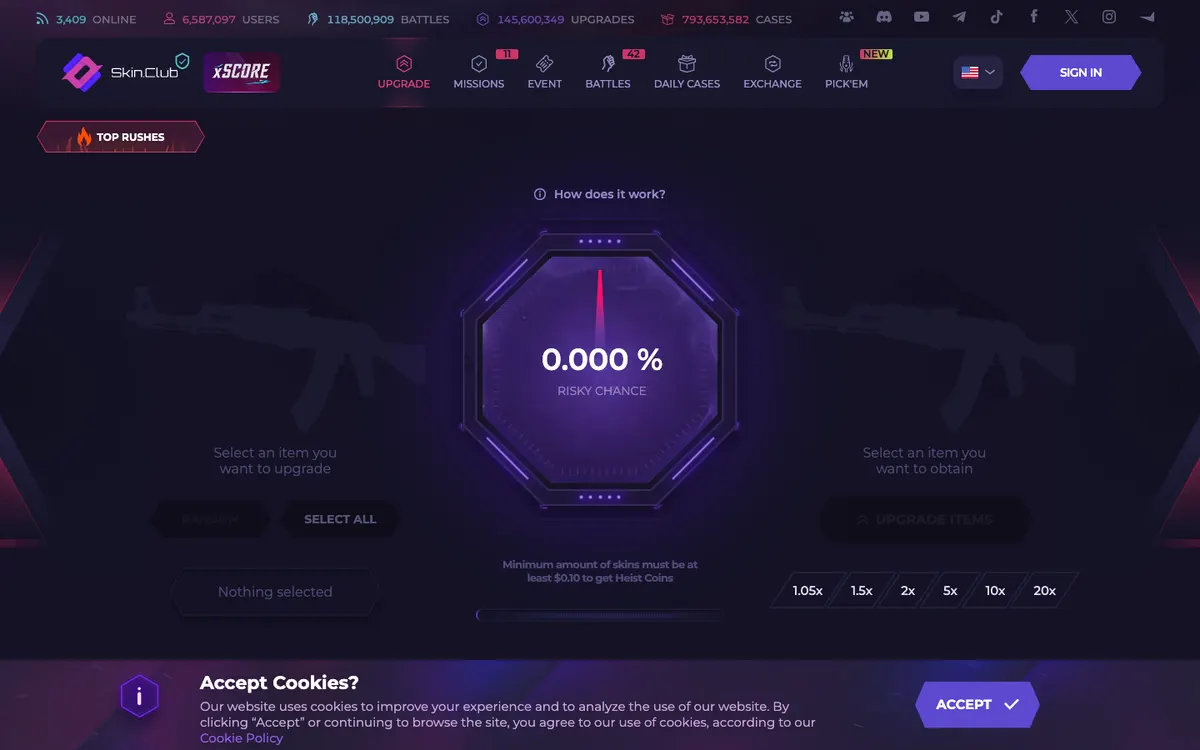
Skin.Club documents an Upgrade mode in which you select skins and choose a target skin. A smaller price gap between the selected items and target means a higher success probability. This is a chance-based game, not Steam's trade-up contract and not a purchase agreement for Medusa. Any Medusa-specific discussion remains conditional on the skin appearing in the current target selector; its availability is not established by the existence of Upgrade.
Skin.Club's official Upgrade interface shows item selection and a displayed chance. This screenshot explains the interface, not current Medusa availability, the condition of a target copy or its withdrawal status.
Read the chance without mistaking it for progress
An upgrade-style game stakes lower-valued items toward a higher-valued target. As the target's value rises relative to the stake, the chance falls. Skin.Club shows the chance before an attempt; read that figure rather than calculating an assumed probability from a target price or multiplier. The operator's margin creates a house edge, so the long-run expected result is a loss of value. No timing, pattern, sequence of attempts or recovery strategy removes that margin.
- If Medusa is absent from the target selector, stop treating Upgrade as an available route to that item. A similar-looking target is not a substitute.
- If the displayed chance is unsuitable for your loss budget, do not attempt to repair it by planning repeated tries. Losses do not create future entitlement.
- If the target appears selectable, check its exact description and current withdrawal conditions separately. Target selection and successful delivery are different stages.
Provably Fair verifies results, not favourable odds
Skin.Club says its mechanics use Provably Fair technology, with roll histories, seed changes, and client and server seeds available to view. It also says other players' results can be checked. Verification concerns whether a result follows the disclosed mechanism; it does not make that result more favourable or eliminate the house edge. Consult the Provably Fair explanation for the verification context, and the game-modes guide to distinguish Upgrade from cases and battles.
Separate a site result from a Steam withdrawal
Skin.Club's documented withdrawal flow is to select items in your profile, choose Take, wait for a Steam trade offer and accept it. Trades are automated through Steam bots. The terms also state that some skins may be unavailable for withdrawal for reasons outside the company's control. The site offers no cash withdrawal, and deposited Credits are internal tokens that cannot be withdrawn or exchanged for cash. An on-site balance is therefore not the same thing as a Medusa held in your Steam inventory.
Skin.Club does not publish a complete fee table, and its terms reserve the right to charge additional fees or change the structure. Do not assume a fee-free route or equate a site valuation with a Steam listing. The fees guide separates documented terms from unspecified charges; the Skin.Club review covers the broader suitability and account considerations.
Cases and battles do not bypass the item pool
Skin.Club also offers custom case categories and case battles. Neither format establishes a Medusa source by itself. A case needs an explicit item pool; a battle adds competition and distribution rules to case opening, not certainty about obtaining this AWP. These modes are 21+ and carry a house edge. If losing the committed items would affect essential spending, avoid the attempt and use the responsible-play guidance.
Medusa checklist before you commit
- Confirm the route: Medusa does not come from a conventional Valve container.
- For a contract, validate input grade, collection representation and eligible outputs before consuming skins.
- For an existing copy, inspect its identity, condition and any variant or pattern claim.
- For Skin.Club, establish current target availability, displayed chance and withdrawal conditions independently.
- Treat uncertainty honestly: neither general Covert odds nor Provably Fair verification promises Medusa.
AWP | Medusa FAQ
No matching questions found.
What collection is AWP | Medusa from?
Which case drops AWP | Medusa?
Is the Medusa drop chance the general Covert percentage?
Can you craft Medusa with a trade-up contract?
Can Souvenir or Covert skins be used in the Medusa contract?
What float range, patterns and StatTrak variants does Medusa have?
Can I upgrade to Medusa on Skin.Club?
Does a successful Skin.Club result mean immediate Steam ownership?
Explore Skin.Club
Links to Skin.Club's official site are independent and earn no commission. →
This guide is independent and informational. Check Skin.Club's official site for current terms.