



To check a Skin.Club result, start with its recorded seeds and roll history—not the opening animation. Skin.Club says all its mechanics use Provably Fair technology, with roll history, seed changes, client and server seeds available to inspect, and other players’ results checkable. Those records are the starting point for verification. This guide explains what to preserve, how a seed-and-hash check works, and where checking the underlying roll differs from checking the awarded item. Case opening, upgrades and battles are chance-based, are for adults aged 19+ subject to local requirements, and carry a house edge.
What Skin.Club says you can check
Skin.Club’s documented products include CS2 case opening, upgrades and case battles. Its official Provably Fair page says the technology applies across its mechanics. The useful part of that statement is access to records: verification needs evidence tied to an identifiable result, rather than a general claim that outcomes are random.
- Roll history: locate the recorded outcome you want to examine.
- Seed changes: establish which seed state belonged to that result.
- Client and server seeds: identify the inputs associated with the calculation.
- Other players’ results: inspect a result beyond your own account history where the interface makes it available.
There is an important boundary: the published overview does not specify a complete hash algorithm, seed encoding, counter format or roll-to-outcome formula. Do not fill those details with an algorithm copied from another case-opening site. A reproducible Skin.Club check must follow the method applicable to the exact mechanic and result.
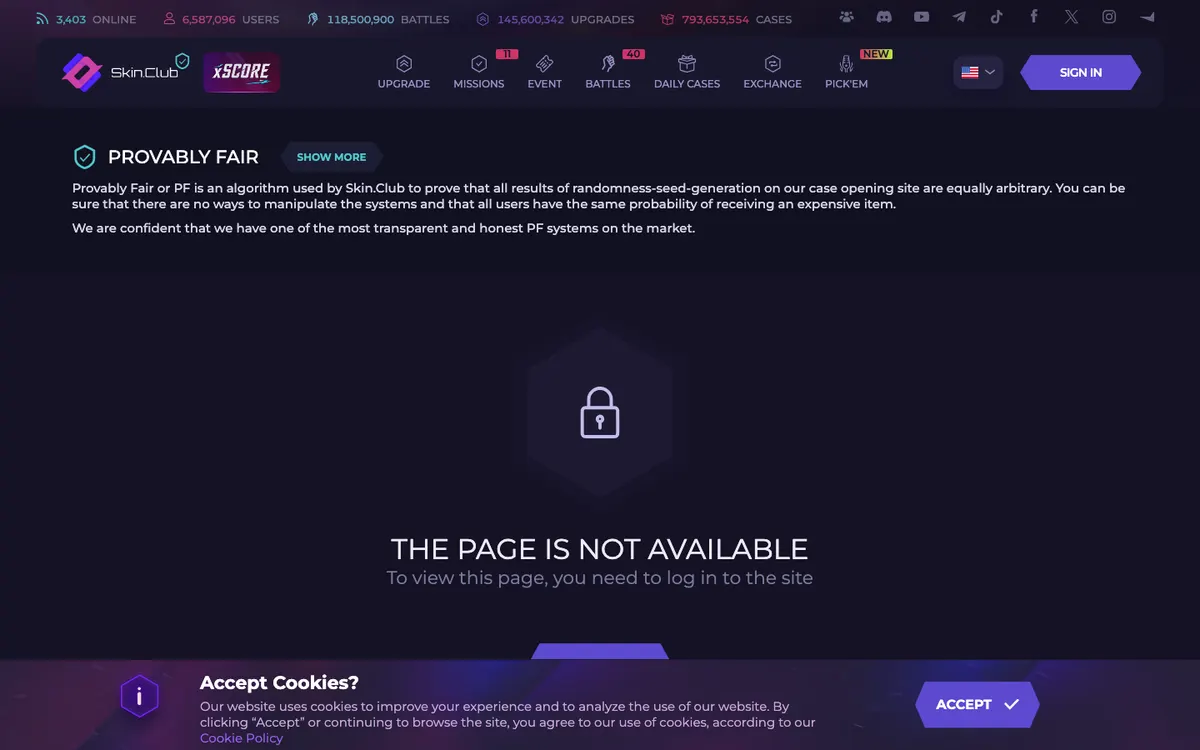
Skin.Club’s official Provably Fair information and result-verification interface. Use the records attached to your actual result; a screenshot of the interface is not evidence that an individual outcome has passed verification.
Understand seeds, hashes and result mapping
The following terms describe general commitment-based verification, not a substitute specification for Skin.Club. The central idea is that the operator commits to hidden information before an outcome, then later exposes enough information to let someone reproduce it. A commitment is useful because it can make changing that hidden input after the event detectable.
| Term | General meaning | Why it matters |
|---|---|---|
| Server seed | An operator-side input used in outcome generation. | Its later disclosure can let you reproduce a result, provided the complete calculation method is available. |
| Client seed | A player-side input combined with other inputs. | The exact value used for the historical result matters, not simply the value currently displayed. |
| Hash or commitment | A cryptographic digest derived from specified input data. | A previously recorded commitment can be compared with the digest of the subsequently revealed data. |
| Nonce or counter | An additional changing input used by some systems to distinguish results. | If the applicable method uses one, using the wrong counter can produce a different result despite matching seeds. |
| Raw output or roll | The output derived from the inputs before applying the game’s outcome rules. | Reproducing it checks the calculation stage, but does not necessarily identify the awarded item by itself. |
| Outcome mapping | The rule connecting a generated value to an item or success condition. | It is needed to verify that the reproduced roll corresponds to the recorded outcome. |
A cryptographic hash is not encryption that you unlock to read the seed. It acts more like a fingerprint: the same input, processed in exactly the same way, produces the same digest. Changing the input should produce a different digest. That makes exact text, encoding and formatting important; a visually similar seed is not necessarily the same input.
The timing matters as much as the match. A hash copied only after an outcome does not establish that the operator committed to that seed beforehand. For a prospective check, preserve the commitment before the relevant result whenever the interface exposes it. For an older result, distinguish between a historical commitment you independently saved and one you are now viewing in the operator’s records.
Know what a successful check actually proves
“Verified” can describe several different checks. A matching seed hash is not the same as reproducing a roll, and reproducing a roll is not the same as confirming a battle’s settlement. Separating these layers helps you state a useful conclusion instead of treating a green verification message as proof of everything.
| Check | What a match supports | What it does not establish |
|---|---|---|
| Revealed seed against saved commitment | The disclosed input matches the commitment under the specified hashing method. | That the outcome offered favourable odds or that every other result was calculated correctly. |
| Inputs against recorded roll | The disclosed inputs reproduce that roll under the applicable algorithm. | That the roll was mapped to the correct item or success condition. |
| Roll against historical outcome rules | The generated value corresponds to the recorded item or result. | That current prices equal the values used when the result occurred. |
| Battle results against settlement rules | The recorded results were allocated according to the selected battle format. | That a different battle mode would allocate those items in the same way. |
| Steam trade inspection | The offer contains the items and counterparties you expect. | That an earlier case opening or upgrade calculation was correct. |
A commitment also has a narrower purpose than proving the quality of the entire random-generation process. A matching hash can show consistency with committed data, but it does not reveal how that data was originally chosen or demonstrate that every possible outcome was handled correctly. Those are broader implementation questions. This distinction applies to commitment-based systems generally; it is not evidence of a problem with a particular Skin.Club result. Keep the claim proportional to the test: a commitment match establishes a commitment match, not a complete audit.
A reproducible outcome can still be an unfavourable outcome. Provably fair technology concerns checking the calculation and its inputs; it does not remove the house edge, make valuable items more likely, or establish that account security, withdrawal availability and every other operational issue are satisfactory.
Prepare an evidence record before calculating
Choose an existing result from the available history rather than opening another case just to test the concept. Keep the original record intact and work from a copy. Screenshots preserve context, while copied text makes exact seed comparisons easier. Neither is a substitute for missing calculation rules.
- Record the result identifier, date, mechanic and any linked case or battle reference shown.
- Preserve the client seed, server-seed commitment and any associated seed-change information available for that result.
- Record a counter or other additional input if the applicable method uses one; do not invent a missing value.
- Save the recorded roll and exact outcome, including the item variant or upgrade target where relevant.
- Keep the probability information, outcome ranges, selected battle mode and valuation context if those are displayed.
- Note whether each piece of information was saved before the result or retrieved afterward.
Be careful with a client seed that has since changed. The current value may belong to later activity. Similarly, a newly selected upgrade target or a currently listed case does not necessarily describe the historical transaction. Verification should use a consistent snapshot of the result, not a mixture of old records and current interface settings.
Preserve exact input text, not just its appearance
Copy technical values into a plain-text record with clear labels. A spreadsheet can reinterpret an input as a number, while a document editor can substitute characters or introduce formatting. Leading characters, spaces, letter case and line endings can matter when the specified calculation processes text. Do not automatically trim or normalise a value unless the applicable method says to do so. A line wrapping visually in a browser also does not necessarily contain an actual line-break character.
Keep an untouched original alongside your working copy, and label any transformation you make for a calculator. This makes a mismatch easier to diagnose: you can distinguish the data displayed by the site from the data your tool actually received. When sharing evidence, include only the disclosed result data needed for the check. Remove account-session information, authentication codes, payment details and unrelated account records; none is needed to explain a mathematical comparison.
How to verify a Skin.Club result yourself
This workflow explains the checks to perform, rather than inventing button names or an undocumented Skin.Club formula. Use the official result records and the technical method provided for the relevant mechanic. Where a required input or rule is unavailable, mark that stage as incomplete instead of treating an assumed value as evidence.
- Identify the exact historical resultLocate the entry you want to check and confirm its mechanic, recorded outcome and associated identifiers. For a battle, distinguish the battle record from an individual opening within it. Saving the parent record and the specific opening avoids comparing inputs from different events.
- Associate the result with its seed stateMatch the client seed, server-seed reference and seed-change history to that result. Do not assume the currently active seeds were used. If the record includes another required input, preserve it exactly. A correct algorithm applied to the wrong seed state is still the wrong calculation.
- Obtain the disclosed server seed when availableGeneral commitment-based systems may keep an active server seed hidden and reveal it only after it is retired. Follow the timing and instructions actually shown for the result. Skin.Club’s overview does not specify a universal reveal schedule, so do not assume that changing a setting immediately exposes every historical seed.
- Establish the exact calculation methodYou need the hash or other cryptographic function, input order, text encoding, any counter handling, and conversion from cryptographic output to roll. Use the method applicable to that mechanic. If only a verification interface is available, distinguish checking through that interface from independently reproducing its calculation.
- Compare the revealed input with the commitmentCalculate the digest using the specified commitment method and compare it with the saved commitment. Preserve leading characters and the exact input text. A match supports consistency with that commitment. If you did not save it before the result, state that timing limitation rather than claiming an independently witnessed advance commitment.
- Reproduce the underlying rollApply the outcome-generation method to the exact historical inputs. Compare the full relevant output before rounding or reformatting anything. A matching commitment alone does not complete this stage: the disclosed seeds must also reproduce the recorded roll under the method that actually governs the result.
- Check how the roll became an outcomeUse the applicable item ranges or success condition to determine what the reproduced roll means. Then compare that outcome with the historical record. For a battle, continue to the selected mode’s settlement rules; checking individual openings does not by itself establish that the final item allocation was correct.
- Write a conclusion with a clear scopeState which stages matched and which remain unresolved. For example, a seed commitment may match while item mapping remains unverified because its historical ranges are unavailable. Keep the original records and your calculation output so another person can follow the same inputs rather than relying on your conclusion alone.
For an independent calculation, use code or a tool you can inspect and match to the applicable specification. A third-party page labelled “Skin.Club verifier” is not automatically compatible. It should not require your Steam password, authentication codes, payment details or account session to perform a mathematical check on already disclosed result data.
Apply the right checks to cases, upgrades and battles
The shared question is whether the recorded inputs reproduce the result. What happens after the raw roll depends on the product. Do not assume that checking a case opening also verifies an upgrade or a battle’s settlement.
Cases: connect the roll to the exact item
For a case opening, the essential second stage is the mapping from a generated value to an item. Use the case configuration applicable when the opening occurred, if available, rather than assuming today’s contents describe the past. Match the exact item variant: wear category and StatTrak status, for example, can distinguish otherwise similar CS2 skins. The animation is not the mathematical record. An item passing near a pointer on screen does not establish how close the underlying calculation came to a different outcome. See the Skin.Club cases guide for the product overview.
Upgrades: preserve the target and success condition
Skin.Club documents an upgrade process in which you select skins and choose a target skin. It says a smaller price gap between the selected skins and target means a higher success probability. That relationship is not a complete mathematical formula. Preserve the original selection, target, displayed chance and any applicable success range. Recreating the selection later may not recreate the historical conditions. To verify the result fully, establish both that the inputs reproduce the roll and that the roll falls on the recorded side of the applicable success condition.
Battles: separate openings from final allocation
Skin.Club lists Regular, Crazy and Sharing battle modes. Preserve the selected mode and player or team arrangement with the battle record. First examine the underlying openings; then check the rules governing how their results are compared or allocated. A reproducible drop does not automatically settle a disagreement about the winner. Conversely, a surprising allocation is not itself evidence of a bad seed calculation. If a result depends on a tie rule or another mode-specific condition, obtain that rule rather than inferring it from the mode name. The game modes guide separates these products.
Check rounding and boundaries before judging a mismatch
In a general roll-based system, an interface may display a shortened representation of a value while the calculation uses greater precision. A displayed roll that looks equal to a threshold may therefore not establish equality in the underlying calculation. Check whether the applicable specification uses an integer, a decimal value or another representation, and whether the displayed record rounds or truncates it. Do not round an intermediate result simply to make your calculator resemble the screen.
Range endpoints need the same care. A mapping must determine which outcome receives a value exactly on a boundary; an upgrade rule must define whether equality satisfies its success condition. These are technical questions, not details to infer from an animation or an approximate chance label. Skin.Club’s overview does not supply a universal boundary convention. If a disagreement occurs at an endpoint, ask for the unrounded relevant value and the comparison rule used for that historical result. Preserve the distinction between a display difference and a genuinely different calculated outcome.
Do not confuse verifiability with favourable odds
A correctly generated random outcome can come from a distribution weighted heavily toward lower-value items. In general, assessing that distribution requires the outcome probabilities and the relevant item values—not merely a successful hash comparison. Expected value describes the probability-weighted value of possible outcomes; it is not a prediction of what your next opening will return. Skin.Club’s provably fair statement does not establish a numerical house edge, and no edge figure should be inferred from the label.
Skin.Club also describes Adrenaline as an informational indicator relating the likelihood of desirable skins to case cost, and says it does not affect the outcome. It is not a seed, hash or replacement for verification. Likewise, checking another player’s valuable drop shows something about that particular record, not what you should expect next. A sequence of disappointing results does not make a valuable result due. Changing a client seed should not be treated as a technique for finding a more favourable sequence.
Troubleshoot mismatches without guessing
A failed comparison deserves investigation, but first isolate the failing stage. Otherwise, an input-copying error, an incompatible tool and an unresolved outcome discrepancy can all look like the same problem.
| Problem | Check first | Useful next step |
|---|---|---|
| The revealed seed does not match the saved commitment | Confirm the seed period, exact copied characters, input encoding and specified commitment method. | Preserve both values and the original result reference. Do not alter inputs repeatedly just to obtain a match. |
| The commitment matches but the roll differs | Check the historical client seed, additional inputs, input order and output-conversion rules. | Confirm that the verifier implements the applicable Skin.Club mechanic rather than another site’s formula. |
| The roll matches but the item appears different | Check historical outcome ranges and the complete item variant. | Compare against the original case record, not a current catalogue entry or abbreviated skin name. |
| Battle openings match but settlement seems wrong | Check the selected mode, team arrangement and applicable comparison or tie rules. | Treat the remaining question as settlement verification, with the full battle record attached. |
| The server seed is not available | Determine whether you are viewing an active seed, a commitment or a disclosed historical seed. | Ask for the applicable disclosure procedure. A hash alone is insufficient to reproduce the seed-dependent calculation. |
| The technical method is missing | Identify which function, encoding, counter rule or mapping is required. | Request the exact specification. Record the check as incomplete rather than substituting a familiar generic algorithm. |
If the official interface reports a match but your independent calculation does not, preserve both outputs before changing anything. Record the tool or code version you used, the technical instructions it implements and the exact inputs supplied. Then compare intermediate stages where possible: commitment digest, generated output, converted roll and final mapping. This narrows the disagreement instead of forcing a premature choice between trusting the interface and trusting your script. An independently written tool can contain errors too; independence is valuable because it enables comparison, not because it makes the tool infallible.
Skin.Club publishes help@skin.club for support. A useful report includes the result identifier, mechanic, relevant seed references, recorded output, your calculation method and the precise point of disagreement. Redact unrelated personal and payment information. The support guide explains how to prepare a focused request; asking “which input or rule explains this mismatch?” is more actionable than sending only a screenshot of a loss.
Keep result verification separate from Steam safety
Skin.Club says trades are carried out automatically by Steam bots, and its withdrawal instructions describe receiving and accepting a Steam trade offer. It does not provide cash withdrawals. None of those operational facts is established by a seed check. A reproduced case result cannot authenticate an incoming offer, prove item availability or explain a delivery restriction.
In Steam generally, a trade offer specifies items on both sides, while a trade hold delays delivery as an account-protection measure. Steam Guard’s mobile authenticator provides authentication for trade and market confirmations. These are separate security mechanisms, not parts of provably fair randomness. Inspect the actual offer and protect your account credentials regardless of whether the preceding result reproduced correctly. See Steam trade safety for that separate checklist.
Use verification without extending your play
Verification is a review task, not a reason to keep opening cases or retrying upgrades. Work from existing records wherever possible. These games are 19+ and carry a house edge; Skin.Club requires the applicable age of majority and lawful use in your location. Set spending and time boundaries before any participation, and stop if checking results becomes part of chasing losses or searching for a supposed pattern. An unresolved technical question can be taken to support without paying for another result. The responsible gambling guide covers warning signs and practical ways to step back.
Quick checklist before calling a result verified
- I have identified the exact result and the seed state that belonged to it.
- I know whether the commitment was preserved before the result or retrieved afterward.
- The disclosed server seed matches the relevant commitment under the specified method.
- The historical inputs reproduce the recorded roll without invented values or undocumented assumptions.
- The applicable mapping connects that roll to the recorded item or upgrade outcome.
- For a battle, I have checked settlement separately from individual openings.
- My conclusion names any incomplete stages and makes no claim about future outcomes or Steam delivery.
If a required element is missing, “partially checked” or “not independently reproduced” is more accurate than a blanket verdict. That distinction keeps the conclusion tied to evidence.
Skin.Club provably fair FAQ
No matching questions found.
Does Skin.Club use provably fair technology?
How do I verify a Skin.Club case opening?
Which hash algorithm does Skin.Club use?
Can I predict a result from the server-seed hash?
Does changing my client seed improve my chances?
Can I verify other players’ Skin.Club results?
Why does my calculation differ from the recorded result?
Does provably fair mean Skin.Club has no house edge?
Explore Skin.Club
Links to Skin.Club's official site are independent and earn no commission. →
This guide is independent and informational. Check Skin.Club's official site for current terms.